Showing posts with label Nereus. Show all posts

Wednesday, August 2, 2017

TFBT: The Nereid Monument


One Saturday in July we arrived at the British Museum about 11:30, just in time for the free tour of the Nereid Monument.  I always thought is was a nympheum; shrine to the Nereids, but it isn't.  Who knew?  Ends up it was the tomb of Arbinas the dynast of Lycia; sort of a sub-king to the Persian King.  
For those that don't know; after Alexander the Great conquered the known world and the Hellenistic age began; being "Greek" was very cool.  The meanest thing a Roman could say about another man's education is that "He has no Greek."  The New Testament was written in Greek.  All the sculptures were Greek.  So it is no surprise that Arbinas built a heroic shrine for himself that looks like an Ionic temple.  
the Hellenistic period, witnessing the diffusion of Greek culture through much of the mediterranean and middle east, a diffusion vastly accelerated by the conquests of Alexander the Great, and the various dynasties established by his generals after his death in 323 B.C. Over the Hellenised domains there was a common ruling class culture, using a common literary dialect and a common education system. The city of Alexandria in Egypt, founded by Alexander in 331 B.C., became a centre of scholarship and letters, housing an enormous library and museum, and hosting such renowned poets and grammarians as Callimachus, Apollonius Rhodius, Aristarchus and Zenodotus. …The Hellenistic period is usually said to end with the battle of Actium in 31 B.C.in which the last portion of Alexander’s empire, Egypt, was annexed by the increasingly powerful and expanding Roman Republic.” (Introduction to the Classical Period, M.A.R. Habibttp://habib.camden.rutgers.edu/resources__trashed/introductions/classical-period/
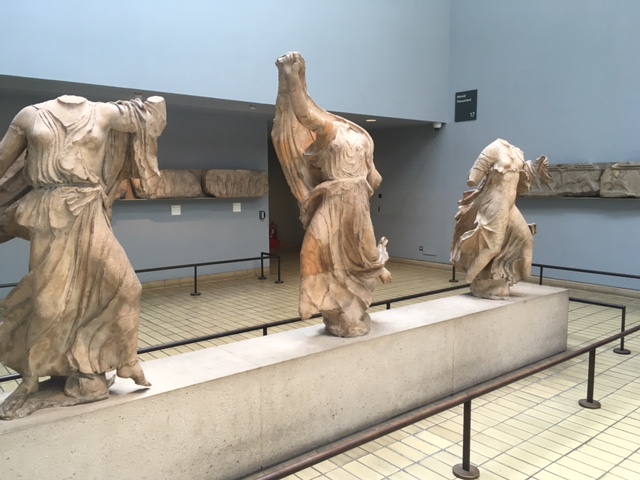


Why Nereids then?  Well according to the British Museum "The three figures are sea nymphs, daughters of the sea god Nereus, riding over the waves on sea creatures.  They are thought to have escorted the soul of the deceased on its journey to the afterlife."  Apparently one, Filippo Buonarroti in 1698 inexplicitly made that comment that Nereids and Tritons in funeral art "represent the journey of the soul to the isles of the blessed." It is hard to tell here, but each figure is balancing on the head of a dolphin or sea-monster being swept along the surface of the wine dark sea.

I didn’t recall too many stories about Nereids as psychopomps, until I started doing a little research: 

·      Proclus in his Chrestomathy 458 tell us that the Nereid Thetis takes her son’s body from the funeral pyre and carries to the island of Leuce.  Leuce being one of the “Isles of the Blest” the Buonarroit, referenced.

·      At the end of Eurpides Andromache, the Nereid Thetis tells her aged, woe-laden mortal husband that she and her dancing sisters will come to fetch him home to live eternally in their father Nereus’ hall. 

·      (I just gotta add that Milton in Comus, has the Princess Sabrina immortalized by Nereus and made goddess of the Severn River) 

·      "Such is the tale told of the fair-throned maids of Cadmus, who suffered mightily, but heavy woe falls before greater good . . . The tale runs too, that in the ocean with the sea-maidens, Nereus' daughters, Ino was given undying life forever." (Pindar, Olympian Ode 2. 22ff)

Probably the myth most supportive of the British Museum’s position that Nereids helped “the soul of the deceased on its journey to the afterlife."  and   Buonarroti’s comment about Nereids and Tritons in funeral art, is the story of Helle.  Little Helle and her brother Phrixus were threatened with an awful fate and only saved at the last minuted by winged ram with a gold fleece.  Her story is told in the Argonautica;

"But lo! As dawn was breaking, the waves opened and scared the flying ship [of the Argonauts], and there stood before them Helle [i.e. the sister of Phrixus) who fell from the Golden-Ram and became goddess of the Hellespont chapleted, the sister now of [the Nereides] Panope and Thetis, and holding in her left hand a golden sceptre. Then she lulled the waves, and looking upon the captains and their leader accosted Jason with gently words…”straightway as I fell, Cymothoe [a Nereid] and Glaucus (a Triton) came swift to my succour; this abode too, this realm the father of the deep himself awarded me, willing justly, and our gulf envies not Ino's sea [the Gulf of Corinth]."  Valerius Flaccus, Argonautica 2. (annotated by Aaron Atsma)

And later;


"[In Colchis stands] the tomb of Phrixus, beside whom stands wrought in marble his sister [Helle],” Valerius Flaccus, Argonautica 5. 195   (annotated by Aaron Atsma)

Most Grecian temples are adorned with friezes depicting wars against centaurs, amazons, giants or barabarians.  The frieze around Arbinas’ “temple” depicts him conquering his own cities in order to reclaim his birthright to rule western Lycia on the Persian king’s behalf.    He was the seventh and the last of his family to rule Lycia.    What do you think?  Was he heroic enough to get a lift from the Nereids to an after life where he and other heroes;

“live untouched by sorrow in the Islands of the Blessed along the shore of deep swirling Oceanus, happy heroes for whom the grain-giving earth bears honey-sweet fruit flourishing thrice a year, far from the deathless gods, and Kronos rules over them; for the father of men and gods released him from his bonds. (Hesiod, Works and Days 156)     

 Did he make it to the Other Side?   Anyone know of other examples of the Nereids or other water gods helping a mortal along to the next world?  

 
Oh and bonus a "picture" of Homer in an adjoining gallery!
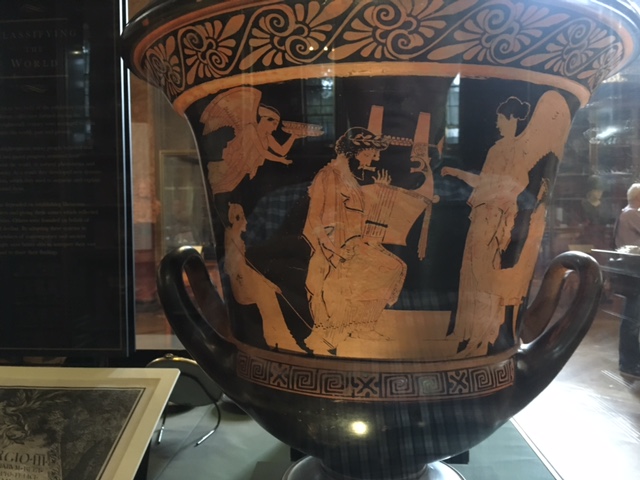


The vase is known as "The Apotheosis of Homer".


Saturday, May 31, 2014

TFBT: Helius, the Titan versus the Hero Peleus


In an article from 1939; Apollo and Sol in the Latin Poets of the First Century B.C. Joseph E. Fontenrose makes the following comments; 

  • Firstly; “All the Latin poets of the first century B .C., distinguish clearly between Apollo and Sol. It is their practice to call both gods Phoebus, and they definitely link Diana with Luna through the medium of Hecate; but wherever the traditional Apollo enters in, he is never connected in any way with the sun, nor is Sol ever endowed with Apolline functions and attributes.”
  • Later in the article; “ Sol and Luna refuse to attend the wedding-feast, though all other gods do, including Apollo… Apparently, the sun and moon have a grudge against Peleus or against both Peleus and Thetis. It is a story known to Catullus, but lost to us.” 

What did Helius and Selene find so disgusting and scornful of the union of Peleus and Thetis?   I suggest several reasons below.


 #1  According to Hesiod, to Nereus and his wife were born in the barren sea fifty daughters greatly beautiful even among goddesses including “Ploto and Eukrante and Amphitrite and Sao, Eudora and Thetis…” (Theogony 240)  Thetis’ father Nereus was the proverbial “Old Man of the Sea” and son of Pontus the primordial sea.  Jenny Strauss Clay and others suggest that he might be “a unique instance of male parthenogenesis.”  (The Generation of Monsters in Hesiod) The uniqueness of Nereus birth is might pre-figure the uniqueness of Thetis’ family; for most of the divine monsters in Greek Mythology are descended from Pontus.  In the same source Clay states the Pontides; “can be considered anti-gods.” 


What I am suggesting here is that Helius and Selene objected to the union of Peleus and Thetis because the brides’ family, the Pontides were not “the right sort of people”. The Olympians and Titans were Ouraniones, descendants of Ouranus; the primordial god of the sky.  Clay suggest that through “intermarriage, the Pontides are rapidly integrated into the Ouranid clan.”  But the intermarriage initially consists of only the marriages of Eos and her father-in-law the Titan Crius who marry descendants of Pontus. (Both Crius and his son seem to disappear after the Titanomachy.) Those marriages resulted in Zeus’ horses and his first allies; the sterile children of Styx.   The rapid part of intermarriage would consist of Poseidon taking Nereid mates to add legitimacy to his lordship over the sea.  In fact for all the talk of the Poseidon and  Zeus competing for Thetis’s hand, none of the other deathless gods who lived upon Olympus chose a lover or a bride from this bevy of prophetic beauties. Possibly, Helios and Selene as the most “skyish” of the Ouraniones most represent this racial bias against the children of Pontus.  


#2 But maybe Helius distaste for Nereus brood is more personal than racial.  According to Aelian, (On Animals 14. 28 ff). To Nereus and Doris were born 50 daughters; the Nereids, and one son; Nerites. Nerites was the most beautiful of men and gods. He served as Poseidon’s charioteer. When he drove his chariot over the waves, great monsters of the deep, dolphins and sons of Triton, sprang up from the deep, galloping and dancing alongside the chariot. His escort would be promptly left behind as over the smooth-spread waves coursed his cerulean steeds. His sisters sported on the peaceful water while he raced across the wine red sea driving a team of four steeds yoked together. His abilities as a charioteer were so great that Helios came to resent the swiftness of the boy and transformed his body into the spiral shell.  Aelian makes it clear he is not speculating any further on this myth


#3 Maybe Helius’ objection wasn’t to the Pontides’ wedding but rather the horror of mésalliance.  As Calypso so elegantly stated in Homer, Odyssey 5. 118;" You are merciless, you gods, resentful beyond all other beings; you are jealous if without disguise a goddess makes a man her bedfellow, her beloved husband.”  The nymph goes on to relate how the gods sent Artemis to slay Helios’ mortal brother-in-law Orion and how Zeus killed Demeter’s beloved Iasion with a thunder bolt.  Aphrodite cursed Helios own sisters with a craving for mortal men and both suffered greatly. ( Pseudo-Apollodorus, Bibliotheca 1.)   


#4  Maybe, what Helius found so repugnant in Peleus and Thetis’ marriage was that it was based on rape.  At first blush that might not  be too convincing based on the normal behavior of  the  (male) gods, but please read further.  First, Greek gods rarely resort to physical rape, in the end their charm and beauty are what over powers their lover.  For example, Helios himself and the mortal Leukothea. Fear gripped her heart. Distaff and spindle fell unheeded from her hands. Her very fear enhanced her grace. Sol, waiting no more, resumed his own true shape, his wonted splendor, the girl, astounded by the sudden sight, yet vanquished by the glory of the god, with no complain accepted his assault.” (Ovid, Metamorphoses 4). 


Second we have proof of Helius objection to rape.  Of all the gods, he was the only to speak up when Hades forcibly abducted her.  The conspiracy against the girl initially consisted of her father Zeus, great-grandmother Gaea and rapist Hades.  Surely some of the Oceanides that accompanied her to the fields that day were enlisted to guide her to the right spot.  Surely Zeus messenger Gossip (Homer, Iliad 2. 93) had ready access to the halls of Olympus.  The silence and lack of support that Demeter found in her time of grief can only be explained by the silent involvement of all the Olympians or their fear to speak up.  Only Helius cried rape.


#5  Finally maybe the Hyperionides disgust at the festivities is so much “sour grapes”.  They both had to work that day (drive their chariots) and in disappointment claimed they didn’t want to go in the first place..


In summary, we may never know what Catulus knew about Helius and Selene’s   grudge against  Peleus and Thetis. But their reasons might have included racism, a family feud, fear of mismatched marriages, revulsion to rape or just plain old sour grapes.