Tuesday, December 20, 2016

TFBT: Samatia Dova, Greek Heroes in and out of Hades


 I recently had the pleasure of reading Dova's, "Greek Heroes in and out of Hades".  She primarily concentrates on the journeys of Odysseus, Heracles and Alcestis, but of course mentions other netherworld wanderers.  I love her writing style particularly when discussing Odysseus.  All Three Parts have a slightly different styles; Dova's study of Alcestis feels more like literary criticism about Euripides than mythological study of Alcestis. Her writing style is incredible dense and detailed.  This is not Mythology 101, something I very much appreciate.  It is a great book, buy a copy so you can underline all the little literary nuggets, you will be looking for later.

This blog post was meant to be a book review, but wanders far afield.  Let me here present my random notes on her fine book.

In Part One Dova notes that "the Odyssey deviates from mainstream mythical tradition regarding the death of Achilles by placing him in the underworld and not in Elysium or Leuce"   Elysium on the Isle of the Blest and the Island of Leuce are paradises set aside for those initiated into the ancient mysteries and the heroes of old.  Homer on the other hand seems to predict nothing but a damp and gloomy afterlife, but in reading Dova I noted three places where Homer possibly acknowledges a nicer option.
·      Now having come here, you have great power over the dead.” Odyssey 11.485-86a” Which acknowledges the gossip (other traditions) that Achilles is a prince on the Isle of Blest
·      “Next I saw mighty Heracles, his shade, actually; Heracles himself is feasting with the immortal gods and has as his wife fair-ankled Hebe, the daughter of Zeus and golden-sandaled Hera.”  Odyssey 11.601.604  Which is a particularly nice option
·      "But for thyself, Menelaus, fostered of Zeus, it is not ordained that thou shouldst die and meet thy fate in horse-pasturing Argos, but to the Elysian plain and the bounds of the earth will the immortals convey thee.” Homer, Odyssey 4.561ff.

She notes a “fundamental deficiency in Odysseus ' heroic profile...he didn't die in his pursuit of glory." She argues that this was the reason for his trip to Hades which bestows "a simulated death experience on a hero who keeps evading death with surprising yet suspicious suppleness."  Which pretty means, that Odysseus didn't have to visit Hades to get directions home from Tiresias.  Others have noted that when Odysseus reports back to Circe she seems to already know what the seer had to say.  Rather going in and out of Hades seems to give our hero some sort of immortality.  

Odysseus has a drunken young sailor named Elpenor that he left behind on Circe’s Island.  Odysseus meets the lad in Hades.  “His death occurs at a moment …moving from sleep to wakefulness” when he wakes during the crew’s departure and “from the top of Circe’s sacred palace to the depths of the underworld” he fell.  Odysseus and Elpenor…become the archetypical initiated and uninitiated.”  More on initiation later.  The forlorn ghost requires the Odysseus return to the island and give him a proper burial
Heap up a tomb for me at the shore of the gray sea, 76 wretched man that I am, so that even those who live in the future will learn about it. 77 Make this ritual act for me, and stick the oar on top of the tomb 78 - the oar that I used when I was rowing with my comrades.” Odyssey 11.75 
Not too many lines later the seer Tiresias requires Odysseus to perform the same ritual once he reaches Ithaca.
shall say that thou hast a winnowing-fan on thy stout shoulder, then do thou fix in the earth thy shapely oar [130] and make goodly offerings to lord Poseidon—a ram, and a bull, and a boar that mates with sows”
Is Odysseus performing heroic rites for the young man to give him a shot at Elysium or Leuce?

One of the characters that Odysseus meets in Hades is Ajax.  Dova has many insightful things to say about Ajax, one of interest at this point; "Ajax signals if not the end of the visit to the underworld, the end of the flashback to Troy and to the end of the heroic world in general."  It is as if Ajax, whose "silence eloquently indicate his unchanged disposition" is nothing but the turning post in a journey which has no purpose than to go in and out of Hades.

Part Two discusses Heracles in Hades, one of the characters Odysseus sees. Dova recalls that "Heracles' dual status after death (Olympus and Hades)...underlines the endless possibilities for redemption available to Zeus' offspring." It is also one of the Homeric hints of a better world to come.  

Dova points out, "Heracles and Odysseus now placed in the privileged position of the initiate."  Dova does not write much on initiation into the Mysteries.  No one does or did because to reveal the Mysteries is to risk being stoned to death by a crowd of angry theater-goers like Aeschylus.  Ends up the playwright never attended the Mysteries so had no secrets to reveal.  I wonder in Achilles and Homer attended the mysteries at Samothrace?  Socrates and Plato the Eleusinian mysteries?) 

The theory is that the rituals of the various mysteries took the initiates on a mystic trip in and out of Hades, thereby insuring them a spot on the Isle of the Blest.  Such a trip Dova insists is "a provisional immortality necessary for any heroic endeavor."  Dova does not mention Achilles here but “provisional immortality” but it strikes me that this is a better reason for Thetis to dip him in the Styx than the usual excuse of invulnerability. (Statius, Achilleid 1. 134 ff ).

Dova says "the abduction of Cerberus which constitutes the reason or perhaps excuse for Heracles presence among the dead."  Once again Dova is suggesting that the supposed reason for our hero to go in and out of Hades is not the given one. In the Footnotes she adds “The story of Heracles’ mission to fetch the cattle of Geryon, like the tale of his descent of Hades to fetch Cerberus is …a heroic journey to the land of the dead.” (Davies 1988 278) 

 Assuming the journey is in itself the purpose to attain "provisional immortality". I suggest that the "turning post" character in Heracles descent is Menoetes the herdsman who challenged the aggressor to wrestle.   Here Heracles wrestles with the herdsman of Hades similarly...
"Heracles: I must save this woman who has died so lately, bring Alcestis back to live in this house and pay Admetos all the kindness that I owe. I must go there [to the funeral at the graveside] and watch for Thanatos (Death) of the black robes, master of dead men, and I think I shall find him drinking the blood of slaughtered beasts beside the grave. Then, if I can break suddenly from my hiding place, catch him, and hold him in the circle of these arms, there is no way he will be able to break my hold on his bruised ribs” (Euripides, Alcestis 839 ff
If you've seen "Bill and Ted's Bogus Adventure" you know that defeating Death (even at Twister) gives the hero the boon of immortality

Part Three is about Alcestis, "And her deed was considered extraordinarily noble by men and gods alike; in fact, the gods impressed by her actions, let her soul come back from the underworld". Likewise Dova says of Achilles "Having earned divine admiration and praise to the utmost...the gods reward him with immortality and transport him to the Islands of the Blessed where he lives a blissful existences to eternity."

I mention it here because Dova spends a lot of time comparing the possible romance between Achilles/Patroclus and Alcestis' husband Admetus with Apollo.  Rather than convince of the romances and her argument by analogy between the two she convinced me of the effeminacy of Admetus.  She suggests that
·      Admetus was the passive member of the hypothetical A/A romance, that 
·      Alcestis' "sacrifice is the very means that cancels the suspension of the husband’s  sexuality" and that
·      "Alcestis assumes male responsibilities towards Admetus who displays almost feminine vulnerability and helplessness". 
One example of Admetus' helplessness is the courtship of Alcestis.  When great numbers of suitors were seeking Alcestis, daughter of Pelias, in marriage, and Pelias was refusing many of them, he set a contest for them, promising that he
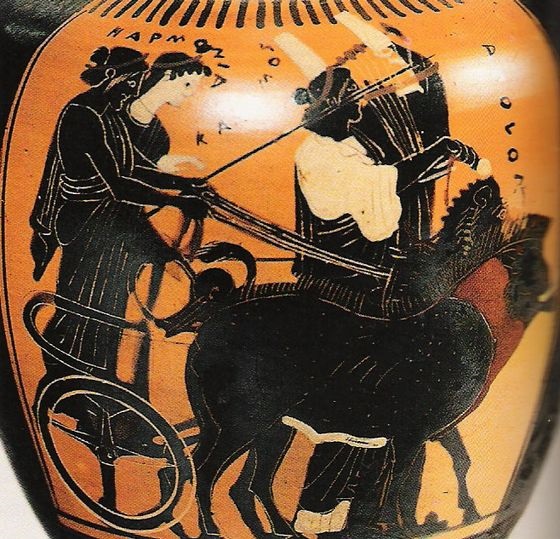
would give her to the one who yoked wild beasts to a chariot. [He could take away whomever he wished.] And so Admetus begged Apollo to help him. Apollo, since he had been kindly treated when given in servitude to him, provided him with a wild boar and lion yoked together, and with these he bore off Alcestis in marriage.  (Hyginus Fabulae 50).  You just got to wonder if the “best man” has to hitch the beasts to the bridal chariot, what other services he has to handle to make the marriage work![i]


Dova’s Footnotes are amazing; just not the references, but discussions.  I love footnotes.  As a child reading Charles Mills Gayley’s “The Classic Myths in English Literature and in Art, Based Originally on Bulfinch's.  I learned more about competitive methods of mythological interpretation than I did from reading the competing scholars book.   Dova’s footnotes are full of just as much wisdom
 
“The visit ends in fear of Persephone’s wrath, when …worries that he might have overstayed his welcome in the underworld.  The queen of the underworld is given an aura of matronly authority comparable to Arête’s, who is listening attentively to Odysseus’ account” Wow!  Talk about Reception!  Also one of the few acknowledgement by Dova that Odysseus is telling this story of his supposed trip to the underworld.    

The adjective “makar” applies to a mortal once in Il 11.68…It occurs fifteen more time in the Iliad always referring to immortals.  In the Odyssey “makar” refers to gods twenty out of twenty-six time

“…soldiers who unable to withdraw physically from combat, withdrew emotionally and mentally from everything beyond their small circle of combat-proven comrades.”  

Dova declares “Heracles and Odysseus, the only Greek heroes to successfully complete a descent to the underworld” You cannot not give Alcestis the same honor because she never actually got to Hades, Heracles ambushed Thanatos at her grave when he came to fetch the woman’s soul.  Still…Dova mentions Theseus who descended with his best friend to kidnap Persephone.  He only returned to the surface with the assistance of Heracles, but Heracles and Odysseus in turn had help.  Orpheus descended in hopes of getting his wife back and returned to the surface.  Princess Semele of Thebes was rescued by her thrice-born son Dionysus and taken to Olympus.  And a handful of people were brought back from the dead by Asclepius.

 The element of fire not only connects Heracles and Meleager in death, but also evokes immortalization procedures performed by a mother or nurse as in the case of Achilles and Demophon. “

“The confrontation between Apollo and the Fates may echo an ongoing antagonism between the old and new generation of divinities ,  see Eumenides 723 where the Furies perhaps in solidarity to the Fates, condemn this behavior of Apollo’s

Beautiful Writing: I just got to include some beautiful pieces of writing. 

"The Embassy Scene serves as the ultimate eye-opener for Achilles...Agamemnon, severely hard-pressed wants to buy him out"...by preserving the hero's glory in the memory of people , honor enables culture to override nature, disabling death's power to condemn a person's name to eternal obscurity.  Achilles enters the Trojan War trusting on the promise of such cultural immortality; when the promise is broken and his honor taken away he struggles with the realization that he needs another reason to die for."

"Meleager steps out of the underworld for a fleeting moment to become Hera les' worthy opponent; the poetic memory of encounters between Homeric warriors is automatically re-activated upon Heracles' arrival as if the visitor to Hades let in a beam of  life-restoring light before the door closed quickly behind him". 


[i] If “wild boar and lion yoked together” for a bridal chariot sounds familiar, it is because the beginning of the troubles at Thebes started with a similar requirement.
Hyginus Fabulae  70 Adrastus, son of Talaus, had daughters Deipyla and Argia. Oracular response was given him by Apollo that he would give his daughters in marriage to a boar and a lion. Tydeus, son of Oeneus, exiled by his father for killing at a hunt his brother Menalippus, came to Adrastus clad in a boar’s skin. At the same time Polynices, son of Oedipus, driven from his kingdom by his brother, came wearing a lion’s skin. When Adrastus saw them, mindful of the oracle, he gave Argia to Polynices, and Deipyla to Tydeus in marriage. 

I have found no great explanation for this odd marriage ritual.  

In the text is an image; it is supposedly in the Louvre a 6th century Attic amphora by the Diosphos vase painting group depicting Harmonia and Cadmus' (Kassmos in the Attic dialect) wedding chariot draw by the same beasts. Of course Graves explains that beasts symbolize the two halves of the Sacred Year, representing the traditional rivalry between the sacred king and his therapon (Graves uses the Celtic word; “tanist”).  

Saturday, December 17, 2016

TFBT; Reception of Ancient Greek Prose

Atticans

Today ya'll translated Xenophon 225 "From there he marched into Thymbrion. There was a spring alongside the road. On this Midas is said to have caught the Satyr." and commented "We think the Satyr is Silenus: at least, he is illustrated below the passage, and is described in the LSJ as a "lewd, goatish fellow" 

This got me to thinking about Thucydides.  Supposedly his book does not include the gods, and yet he says tHe Spartans visit Delphi and ask about attacking Athens. The god says yes, and that he will be with them. Anyone whose read the opening of the Iliad know what happens next. The Spartans enter Attica and Apollo’s bowstring starts humming and shafts of plague sail into the city.  Within the year of Pericles famous speech he, all his family and a large portion of the Athenians were dead by Apollo's shafts.  Thucydides has to write in terms that his audience understand and expected. Plus foreshadowing is a common literally devise

So I find it interesting than Xenophon who seems to write without including gods  as characters in his stories pulls over  at a little roadside spring  to introduce us to Silenus and remind us of the story of another king, Midas of the golden touch

The story of Midas and Silenus is "Midas entertained him generously, and gave him a guide to conduct him to Liber's [Dionysos'] company. Because of this favour, Father Liber gave Midas the privilege of asking him for whatever he wanted. Midas asked that whatever he touched should become gold." (Pseudo-Hyginus, Fabulae 191 ) You probably know or can imagine all the various multiform tragedies that follow.

My thought is; if Thcydides was trying to forewarns us of the doom of Athens by reminding us what Apollo can do before a beseiged city, is Xenophon likewise warning us of an approaching rash request on the part of Cyrus or they hosting of a man nor diety?


Friday, December 2, 2016

TFBT: The Fathers of the Achaeans


We often contrast Odysseus and Achilles, I got to thinking that maybe a similar contrast existed between their fathers.

 Using the short biographies at www.mythindex.com I started making a list. I ended up finding more similarities than I expected. Both were alive during and after the Trojan wars, had their kingdom overrun, saved by their grandsons, maybe married a pregnant bride, fathered a son and a daughter, hunted the Calydonian Boar, sailed aboard the Argo and were made young again by some goddess at the end of their lives.

These surprising similarities got me thinking about the rest of the characters in the Iliad. Menelaus and Agamemnon’s father was not alive, nor Diomedes’. Nestor and Priam’s fathers were not alive. I haven’t started looking, but I am pretty sure Neleus, Atreus and the fathers of the Epigoni were too busy battling one another to sail on the Argo. I wonder, if with a broad-brush, the events (Theban Wars, Boar Hunt, Argo) of the father’s lives affect the son’s. 

The lists of The Crew of the Argo (Wikipedia), the Epigoni (Wikipedia), the Seven Against Thebes (Wikipedia), the List of the Calydonian Hunters (Wikipeida) and list of the Leaders of the Achaeans (Maicar) is a lot of data to sort through.  But here goes.   Rather than trying to set up a massive database and then trying to sort the data, I picked individual hypotheses to test.  

Hypothetis One;  If your father died at the first Theban War;  you had an extraordinary chance of surviving the Second Theban War, surviving the bulk of the Trojan War and being part of the ambush in the Trojan Horse.  Research; Six out of Seven Against Thebes died, but only one out of their seven sons (the Epigoni) died in the Second Theban War.   Of the six remaining Epigoni, the Bibliotheca list four them in the Trojan Horse; Diomedes, Euryalus, Sthenelus and Thersander

Hypothetis Two; If you were an Achaean hero at Troy your father (grandfather or you) fought the Calydonian Boar and/or boarded the Argo.  Research   Wrong!  Only half the Achaean leaders had fathers fighting the boar or boarding the Argo, including Agamemnon, Menelaus and Diomedes.   

          Hypothetis Three; Why aren’t their father’s listed among the boar hunters?  Why did they miss the boat?  It is a geographic or racial thing?  

                     Hypothetis Four; Apparently Menelaus and Diomedes' fathers were busy with cannibalistic dinners rather than boating or boar hunting.  The other thing that M & D have in common is they were both beloved of the gods.  Menelaus was promised the Isle of the Blest by Proteus and Athena gave Diomedes the cup of immortality intended for his father.  I dont know yet if the link between your father's involvement in canniballism and your blessedness applies to the heroes in item three. (I doubt it).   But elsewhere we fan note the Tantalus served up human flesh and his son Pelops was loved by the gods.  (Well loved by Poseidon at least!). If we believe the stag Odysseus killed and ate on Circe''s island was a transforned man it follows that she sould make Odysseus'  son Telemachus immortal.

Sunday, November 20, 2016

TFBT: Review of Thucydides


At the Kosmos Society 1 the Attica Greek study-group is translating excerpts of Xenophon’s 
Anabasis .2  The book is about the campaign of Cyrus the Younger, to wrestle the Persian throne from his brother Artaxerxes II.  Meanwhile the Book Club this month is Thucydides, The History of the Peloponnesian War. Both books cover the same historical period and often the same characters.  Thucydides loses by this comparison.

Thucydides briefly describe the fifty years between the end of the Persian Wars and Peloponnesian War. As I am reading his rapid description of who attacked whom when, I thought, “Are these people crazy?” But then I recalled Nestor’s speechs about the war at Pylos and with the Amazons. Thucydides people sound like and behave like Thucydides. Of course Nestor is a better story teller.

The whole war started with a civil strife in the community of Potidaea.  It was sort of the Archduke Ferdinand of the Peloponnesian War. Talk about self-fulfilling prophecy with the Athenians and Potidaea.  Worried that the Potidaeans might revolt, the Athenians demanded they tear down their walls, so the Potidaeans had to revolt and ask Sparta for help.

The Spartans visit Delphi and ask about attacking Athens. The god says yes, and that he will be with them. Pericles gives an incredibly vain and arrogant eulogy.  Apparently he did know about hubris or knew about the opening of the Iliad and anger   Apollo. The Spartans enter Attica and Apollo’s bow starts shooting shafts of plague into the city.  Within the year of Pericles famous speech he, all his family and a large portion of the Athenians were dead by Apollo's shafts. 

Questions;

  • “Spartan feeling was at that time very friendly towards Athens on account of the patriotism which she had displayed in the struggle with the Mede.”  What's Patriotism mean here?
  • General Pausanias, Sparta Governor of Byzantium and brutal liberator of the Ionians was charged with many things.  “The charge of Medism formed one of the principal, and to all appearance one of the best founded articles against him."  So what does Medism mean?

Interesting tid-bits:

  • So, according to Xenophon, 80 years after the fall of Troy the Dorians and Heraclides became masters of Peloponnesia
  • There were no navies of any account in Hellas until the expedition of Xerxes
  • Sparta had the same government for 400 years
  • The statue of Athena in the Parthenon contained forty talents of pure gold in her jewelry and it was all removable.”

Our Book Club is studying the first two books of Thucydides history.  I won’t be reading any further.

­­­­­­­­­­­­­­­­­­­­­­­­­___________________________________________________

  1.  Formerly Hour 25, but still an online community for classical studies
  2. From  John William White's  First Greek Book) 


Friday, November 18, 2016

TFBT: The Gods of Manhattan

My wife took me to Le Relais de Venise, a French, all-you-can-eat steakhouse to celebrate my birthday a week early.  As we walked around New York City I realized the old gods still abound.  Here is who I saw;


Pallas Athena reigning over the Great Dionysia where all the famous Ancient Greek tragedies were performed. More specifically in this case the Radio City Music Hall and its Christmas Spectacular.  Here is the line to get in to see the Rockettes perform. 


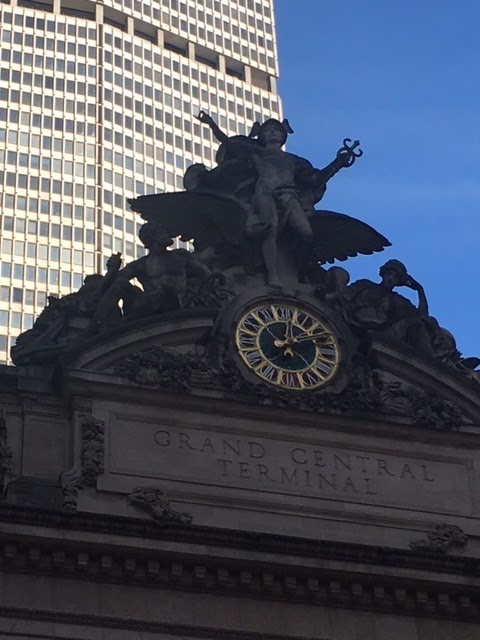
Hermes, god of commerce presiding over the Grand Central Terminal.  And some of the commerce within that my wife was particularly interested in.


The Nymph Daphne was honored at this Greek restaurant. Greek food is very similar to the Lebanese food I grew up on.  I had stuffed grape leaves and my loved the baklava.  The tavern claims on its website;Apollo's first love was the nymph Dafni.  As he pursued her, she called upon the gods to help her escape him and was immediately transformed into a laurel tree.  Still in love with her, Apollo vowed to always wear a crown of laurel.  As the originator of the Pythian Games, and as the god of poetry, he swore to crown all victors, heroes and poets with wreaths woven of laurel leaves.”  I saw the crowns of laurel on the wall!

 
Athena Parthenos recently took command of the lobby at the Metropolitan Museum of Art.  This is a life-size (if you are a god) Roman copy of the lost statue at the Parthenon.  Knowing you will find a surprise in hand if you check out the rear of Farnese Hercules, I checked out Athena from behind and spotted her hair braided back in to a pony-tail.  A detail too high up to notice when I visited the Parthenon in Nashville.


Prometheus Bound a little differently at Rockefeller Center than tradition says; no eagle, no mountain, no exposed entrails.  Ends up the friend of the human race and giver of fire was just being protected during the decorating of the Christmas tree.  


 Meanwhile his brother Atlas stands nearby upholding the cosmos while gazing upon the house of another god; that is St. Patrick’s Cathedral.


 Nike, goddess of Victory is honored in the southeast corner of Central Park, where our carriage ride ended. Of course maybe she was there to honor General W.T. Sherman.


         And yes, it was a spectacular and divine way to celebrate by b-day! 


Wednesday, November 9, 2016

TFBT: The Daemons Lykos and Chimaireus

Do you know about Lykos and Chimaireus, the sons of Prometheus?  Neither did I and I have a reputation  for an “encyclopaedic knowledge” of Greek Mythology.  (My friends say the nicest things to me!)  Apparently, Cassandra, otherwise known a Princess Alexandra of Troy knew about them.  She rants about them in the book named for her.   (Lykophr. 132, with scholia and Tzetzes)   

They were the sons of Prometheus and his niece Celaeno, daughter of Atlas.    This is a rarely known fact to those of us in the habit of just using Hesiod’s Theogony as a genealogical resource.  However, marrying his niece, (a common practice in Greek myths) relieves us of the problem of Hesiod’s "Clymene".  The poet marries off this Oceanid first to Iapetus, Prometheus’ father, then to Prometheus (Yuck!) and finally to the Titan of the Sun, Helios.     

Regardless of their titanic ancestry, it appears that Lykos and Chimaireus, were mortal.  Menelaus was sent to Troy to propitiate the brothers and enquired after their tombs.  A plague raged in Sparta and with the usual ambiguity the Oracle at Delphi sent Helen’s husband to the Troas to perform rituals in the honor of the sons of Prometheus.   

Of course this state-visit is what prompts the Trojans to visit Sparta, and consequently Helen’s abduction and the first great war in the western world and then the reduction of the weight of the tribes of men upon the shaggy earth.   

Nothing more is known about Lykos and Chimaireus.   

Of course Robert Graves “Paris and Helen; q” told this story better than I in  The Greek Myths  and Samson Eitrem has some interesting asides and speculation in

“Lykos and Chimaireus.” The Classical Review, vol. 34, no. 5/6, 1920, pp. 87–89. www.jstor.org/stable/697772